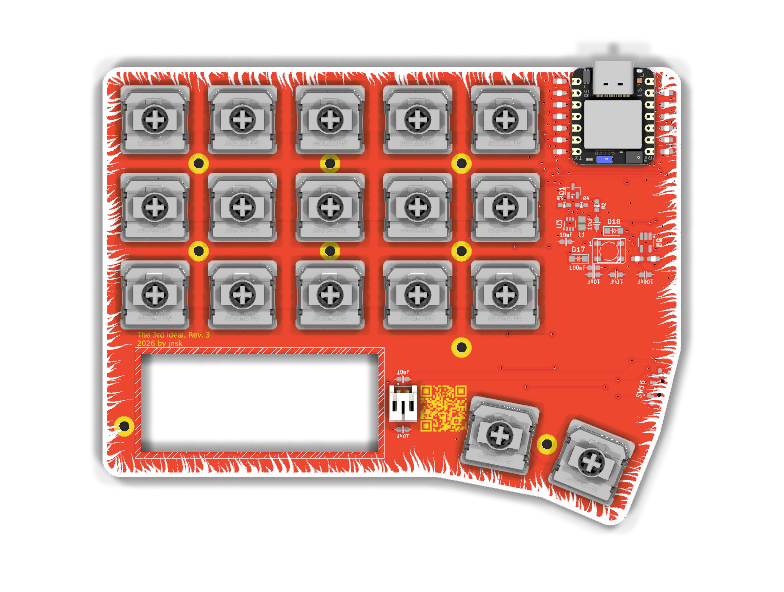
3rd_ideal
v0.3.0
96 footprints · 2-layer · 126 × 99 mm
Errata
E1.1 — via-in-pad causing soldering issuesfixed
- Soldering and reflow issues caused by vias in pads; particularly SO-523 diodes tend to tombstone / not connect at all.
E1.2 — SO-523 diodes difficult to hand- or reflow-solderopen
- SO-523 diodes are too small to hand-solder comfortably; hot-air reflow gun blows them away.
E1.3 — Status LED (and any +5V load) loses power on batteryfixed
- The WS2812B in led.kicad_sch is wired to the +5V global label, which traces straight to the XIAO's VBUS pin.
- Confirmed by multimeter: VBUS is USB-only on the XIAO nRF52840 — it is never backfed from the battery. Per the XIAO's own schematic, BAT+ only feeds the BQ25101 charger and, via a diode/FET power-mux (D1/Q1) into the SGM2040 LDO, the 3V3 rail — never VBUS. LEDs (or anything else) wired to +5V go dark the moment USB is unplugged.
- Fixed: TPS61222 boost converter (U3) added in bat.kicad_sch, with the 4.7uH/10uF/10uF network from the TI typical application. It is fed from the switched BAT+ node, so SW16 still kills the rail and the LED can't drain the cell with the keyboard off.
- Q1 (2N7002K) senses VBUS through R3/R4 and holds EN low whenever USB is present; R2 pulls EN up to BAT+ otherwise. R4 is the gate pull-down that keeps Q1 defined when VBUS floats after unplugging.
- The boost output reaches the LED rail through D17 and USB reaches it through D18; the WS2812B and its level shifter now run off LED_VDD instead of +5V.
E2.1 — SO-523 diodes difficult to hand- or reflow-solderopen
- SO-523 diodes are too small to hand-solder comfortably; hot-air reflow gun blows them away.